English Français
The Painter
As already mentioned in the biography, in 1961, Maria Krull settled in the town of Ladispoli. It was there, one night at the age of 52 that she awoke with a sudden impulse and began to paint.
The landscape surrounding Ladispoli is among the most remarkable and culturally rich in all of Italy. This is the heart of ancient Etruria, a region steeped in history and myth, near Cerveteri, the ancient city of Caere, one of the most extraordinary sites of its kind.
Etruscan towns were founded according to sacred religious principles and imbued with spiritual essence. Around Caere, and particularly near Ladispoli, the entire landscape seems to be infused with these “sacred” qualities. So too are the people, descendants of this ancient civilization for the artist.
From childhood, she was fascinated by the human face and the unique individuality expressed in each head. Through her dialogue with the inhabitants of this ancient region, Maria Krull perceived the living legacy of the Etruscan descendants, a presence that inspired and animated her work. Among her paintings, some are titled “Sacred Head.” These heads reflect the world they once knew and Maria Krull was deeply moved by “the aura of its magic.” For her, any trace of ugliness vanishes when something genuine emanates from a person or a landscape; this, she said, is the noble expression of the spirit.
If visitors to Ladispoli walk all the way to the Etruscan necropolis, it will be a remarkable experience. After taking in the mystery of the surrounding landscape and stepping into the darkness of a tumulus, the impressions of their journey will begin to echo within them. This echo is one of colour, deep, resonant, and emotional. You carry the landscape’s essence with you into the tomb. Maria Krull captured and transformed these impressions into colour. For her, colour is what expression is to the face, just as emotion is shaped in sculpture through sculptural materials; it is conveyed in her paintings through colour.
For Maria Krull, the “sacred features” of the Etruscan landscape merged with her visionary imagination. “I began to paint to capture inspiration,” she said, and she aptly named a series of works “Sacred Impressions.” There is a clear connection between her artistic process and a meditative state: a waiting for inspiration, a creative moment that demands freedom from the influence of other artists.
In “Joy and Sorrow”, for example, the dancing figures and torsos appear naturally. The depiction of dancing women recalls Etruscan frescoes.
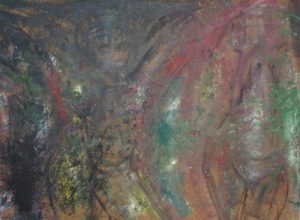
Paintings such as “In Holland” demonstrate Maria Krull’s mastery of proportion and harmony, qualities she believes essential, stating, “Without the right proportions there cannot be order.”
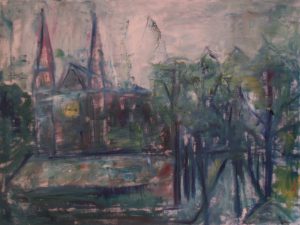
The impact of her paintings derives primarily from their peculiar expressive quality. Hints of form lie layered over blurred patches of colour, so that figures and faces emerge from the hues as if only for a fleeting moment. It is precisely this notion of transient appearance and disappearance that renders the images fascinating, a suspended state between what is no longer formless and what is not yet fully formed.
Maria Krull’s paintings are reminiscent of well-known painters in terms of style, atmosphere, and thematic concerns. Her paintings can be situated in a lineage that combines the religious mysticism of Georges Rouault and Emil Nolde, the psychological depth of Edvard Munch and Oskar Kokoschka, and the expressionist energy of Chaim Soutine and the German Expressionists.
Throughout the 1960’s, Maria Krull participated in many exhibitions, mainly in Rome, and had two solo exhibitions and received numerous awards.
She painted mostly oil paintings. An evolution and different periods are clearly marked and visible but with recurring themes. In this catalogue, as you will see, her paintings are divided into 7 groups:
1 ABSTRACT (19 paintings) 2 FACES, HEADS, FIGURES (30 paintings) 3 GEOMETRIC (39 paintings) 4 HOUSES, LANDSCAPES, TOWNS (26 paintings)
5 BIBLICAL THEMES, JESUS (10 paintings) 6 PORTRAITS (13 paintings) 7 WOMEN, WOMEN’S NUDES (18 paintings).
Paintings by Theme
ABSTRACT (19 paintings)
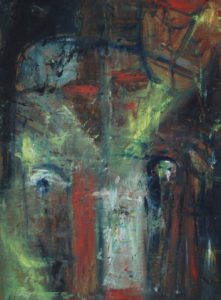
These paintings lean towards abstract expressionism. The layering of pigments and blending of colours suggest an exploration of emotion and atmosphere. The dominant tones are deep reds, greens, blues, and earthy blacks/greys, with occasional bursts of yellow highlights. The contrasts between darker, muted tones and sudden luminous patches create a sense of tension and mystery. The paintings have an almost dreamlike or introspective quality.
FACES, HEADS, FIGURES (34 paintings)
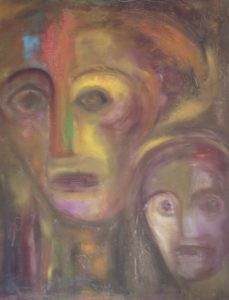
Many of the paintings focus on distorted faces with large eyes, hollow expressions, and mask-like qualities. The backgrounds are often dark, textured, and layered, reinforcing a sense of mystery, depth, and psychological tension. These paintings could be read as an exploration of: the blurred line between body and spirit.
GEOMETRIC (39 paintings)
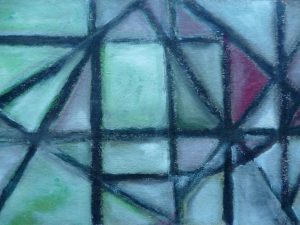
Abstract geometric in style: Each painting prominently uses geometric forms (triangles, circles, intersecting lines, grids, and polygonal shapes). The artist seems to be exploring abstraction through structure and shape.
These works likely aim is to balance geometry with emotion, combining the rigid precision of geometric shapes with the expressive potential of colour and brushwork.
HOUSES, LANDSCAPES (26 paintings)
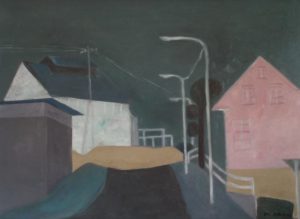
The landscapes are mainly Italian and northern European. These works lean toward expressionism with touches of abstract and surreal qualities. The artist seems less concerned with realism and more with mood, memory, and atmosphere. Visible brushstrokes, layering, and blurred edges suggest an intention to capture fleeting impressions rather than concrete detail. Nature (trees, skies) and human-made structures are juxtaposed, often merging into one another. The mood ranges from nostalgic and dreamy to unsettling and sombre.
JESUS and BIBLICAL THEMES (10 paintings)
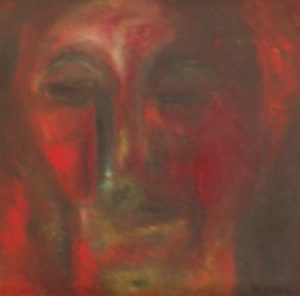
These works appear expressionistic, with heavy emotional undertones. Strong use of muted, dark, and earthy tones (reds, greens, browns, and blues), often conveying suffering, spirituality, or existential struggle. The figures are simplified, elongated, or abstracted, yet remain recognizable. The brushwork is gestural and loose, evoking atmosphere rather than detail. Adam and Eve, or symbolic male-female pairs, rendered in contrasting colours (red versus. green, light versus. dark).There are groupings of heads and bodies, with haunting, mask-like faces, conveying collective suffering, anonymity, or shared humanity.
PORTRAITS (13 paintings)
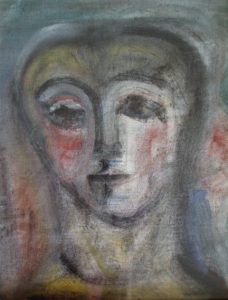
These works are dominated by human faces, distorted or simplified, with exaggerated eyes, lips, or outlines. They are not naturalistic but rather emotional “masks.” Muted but striking colours—reds, blues, greens, and purples—are layered and textured, giving the works a raw, almost unfinished intensity. The use of blue is particularly strong, lending a cold, melancholic tone. Rough, gestural strokes suggest inner turmoil or hidden emotion rather than physical likeness. These are not just depictions of people but emotional states. The faces look haunted, melancholic, or reflective, evoking loneliness, fear or contemplation. Some of the portraits recall saints or icons, almost like modern reinterpretations of religious imagery. The mask-like faces also reveal an interest in essential, primal expressions of humanity. These paintings likely represent the artist’s exploration of the human condition: anxiety, alienation, mortality, and spirituality.
WOMEN & WOMEN’S NUDES (18 paintings)
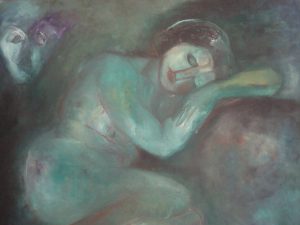
The focus seems to be human form and emotion. The female nudes are depicted not in an idealized classical sense but in a raw, introspective, and sometimes haunting way.
Many of the figures look contemplative, melancholic, or isolated. They suggest themes of loneliness, intimacy, and vulnerability. The women are shown in poses that convey strength but also fragility. This could indicate an exploration of identity, sexuality, and existence. Several pieces have a surreal, almost ethereal quality, where the figures blend into the environment. The heavy use of reds, greens, and blues adds emotional resonance. Reds suggest passion, tension, or even pain; greens and blues give a ghostly, introspective effect. Rather than portraying external likeness, the artist seems to want to capture internal states—dreams, anxieties, solitude, or intimacy. There is a strong sense of existential questioning in these figures, as if they are caught between presence and absence, material and spiritual.